Changing the game for data collection in the Caribbean
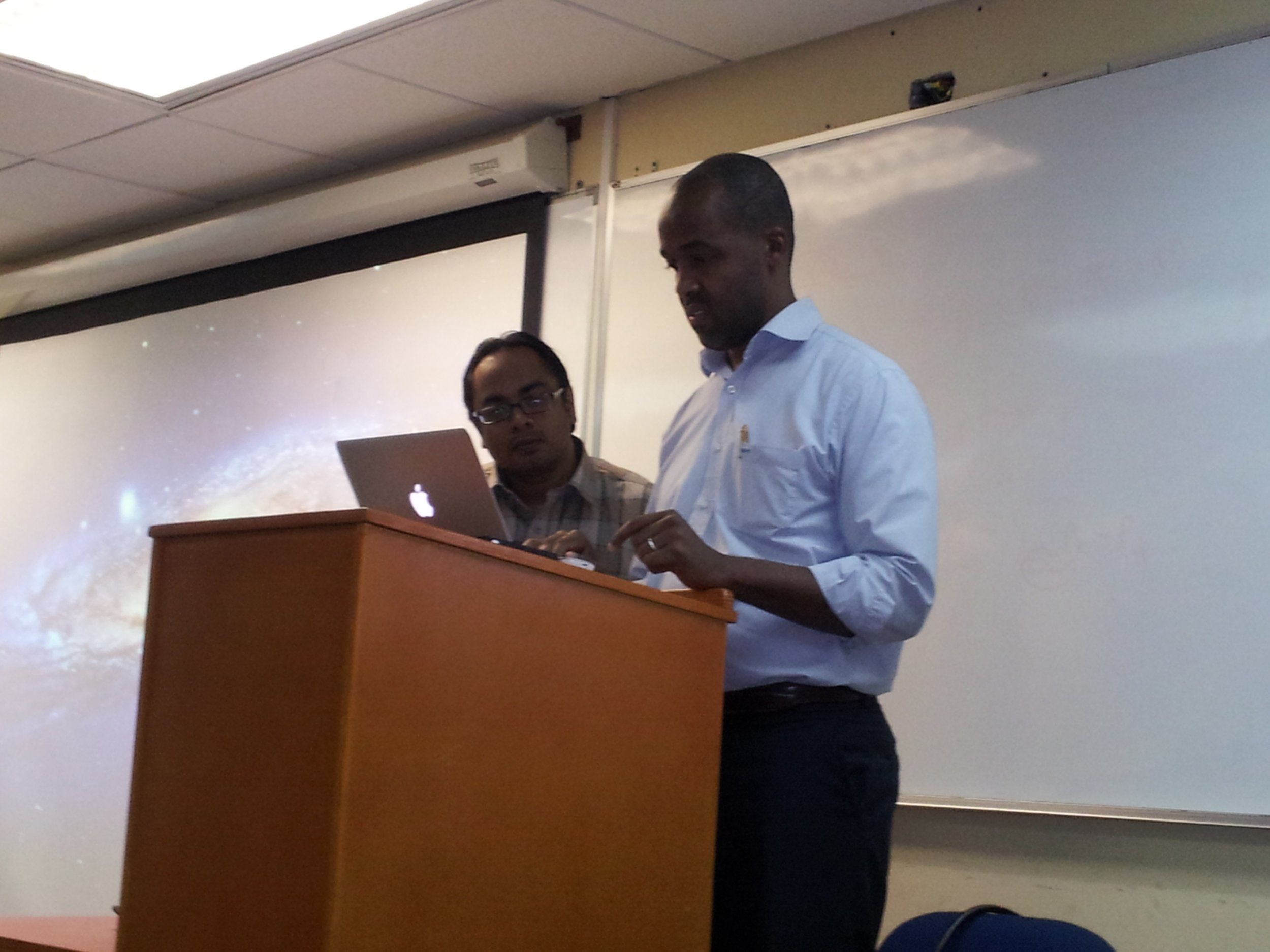
CAPTION: Dr Kenfield Griffith, CEO, mSurvey and Anil Ramnanan, PhD student at The University of the West Indies (UWI) Department of Computer Studies, at mSurvey’s workshop on Data Collection and Surveying using Mobile Technology, held at the Max Richards Building, Faculty of Engineering , UWI St Augustine on March 28, 2014. PHOTO: GERARD BEST A mobile SMS-based survey service from a Caribbean-based company could change the way data is collected and analysed in the region.


If Kenfield Griffith has anything to say about it, his company will soon be adding potent fuel to the digital revolution smouldering quietly throughout the islands of the Caribbean.


Born in Montserrat and of Barbadian extract, Griffith is the CEO of mSurvey, a mobile surveys company based in Kenya. Kristal Peters, Director of Business Development and Strategy, runs the company’s Trinidad and Tobago office.


"It's Friday morning. Let's create a survey together," Griffith says to a group of relative strangers gathered in a small room in the Max Richards Building at the Faculty of Engineering of The University of the West Indies, St Augustine for mSurvey’s workshop on data collection and surveying using mobile technology.


His confidence seems well placed. Within minutes, the demo survey is set up and sent to a pool of prospective participants located in Kenya and Trinidad and Tobago, who immediately start returning their responses via SMS technology. Soon, their data start streaming in to a dynamic web page, which aggregates and visualises the survey results in real-time. In no time at all, the roomful of workshop participants, about fifty in all, are analysing the fresh data.


The audience is an interesting mix of academics, researchers, policy makers, mobile carrier representatives, students and software developers, and many seem eager to learn more.


“Do you sell data to third parties?” asks one man seated toward the middle of the room.


"We have the technology that folks use to get other people's data. But we don't sell anyone's data to third parties," Griffith replied.


Moments later, he clarified his business model. The primary service that mSurvey provides is to help people, businesses and organisations to use mobile technology to get the precise data they need to make high-impact decisions quickly.


"We're trying to solve a problem here and that problem is getting data.”


To have some idea of what Griffith means, you need only to have tried to get survey data quickly and reliably in the Caribbean context. For many organisations trying to use survey data to harvest meaningful insights and increase their ROI, the biggest stumbling block is the inability to gather data in the first place. Door-to-door surveys are costly and painfully slow. Open data sources like the World Bank are always just a click away but don't necessarily give the specific insights required for contextual decision-making. And commissioned online surveys are challenged by the limits of the local population's access and connectivity to the Internet. By some estimates, residential broadband Internet penetration in Trinidad and Tobago, for example, remains as low as 45%.


“Getting information in emerging markets is a pain point for most of us,” Griffith said.


But for every problem, a solution. Mobile penetration in Caribbean islands like Trinidad and Tobago can be as high as 140%. Everyone, statistically speaking, has a phone...or two. So the mSurvey platform allows the entire survey process to be completed over a regular mobile SMS plan at no cost to participants. Respondents don’t need mobile or Wi-Fi broadband Internet connection, nor even a smartphone.


For mSurvey, the ubiquity of the mobile phone has become the answer to one of the region's biggest obstacles to data collection.

Surveying the region: Changing the game for data collection in the Caribbean

A mobile SMS-based survey service from a Caribbean-based company could change the way data is collected and analysed in the region.

If Kenfield Griffith has anything to say about it, his company will soon be adding potent fuel to the digital revolution smouldering quietly throughout the islands of the Caribbean.

Born in Montserrat and of Barbadian extract, Griffith is the CEO of mSurvey, a mobile surveys company based in Kenya. Kristal Peters, Director of Business Development and Strategy, runs the company’s Trinidad and Tobago office.

"It's Friday morning. Let's create a survey together," Griffith says to a group of relative strangers gathered in a small room in the Max Richards Building at the Faculty of Engineering of The University of the West Indies, St Augustine for mSurvey’s workshop on data collection and surveying using mobile technology.

His confidence seems well placed. Within minutes, the demo survey is set up and sent to a pool of prospective participants located in Kenya and Trinidad and Tobago, who immediately start returning their responses via SMS technology. Soon, their data start streaming in to a dynamic web page, which aggregates and visualises the survey results in real-time. In no time at all, the roomful of workshop participants, about fifty in all, are analysing the fresh data.

The audience is an interesting mix of academics, researchers, policy makers, mobile carrier representatives, students and software developers, and many seem eager to learn more.

“Do you sell data to third parties?” asks one man seated toward the middle of the room.

"We have the technology that folks use to get other people's data. But we don't sell anyone's data to third parties," Griffith replied.

Moments later, he clarified his business model. The primary service that mSurvey provides is to help people, businesses and organisations to use mobile technology to get the precise data they need to make high-impact decisions quickly.

"We're trying to solve a problem here and that problem is getting data.”

To have some idea of what Griffith means, you need only to have tried to get survey data quickly and reliably in the Caribbean context. For many organisations trying to use survey data to harvest meaningful insights and increase their ROI, the biggest stumbling block is the inability to gather data in the first place. Door-to-door surveys are costly and painfully slow. Open data sources like the World Bank are always just a click away but don't necessarily give the specific insights required for contextual decision-making. And commissioned online surveys are challenged by the limits of the local population's access and connectivity to the Internet. By some estimates, residential broadband Internet penetration in Trinidad and Tobago, for example, remains as low as 45%.

“Getting information in emerging markets is a pain point for most of us,” Griffith said.

But for every problem, a solution. Mobile penetration in Caribbean islands like Trinidad and Tobago can be as high as 140%. Everyone, statistically speaking, has a phone...or two. So the mSurvey platform allows the entire survey process to be completed over a regular mobile SMS plan at no cost to participants. Respondents don’t need mobile or Wi-Fi broadband Internet connection, nor even a smartphone.

For mSurvey, the ubiquity of the mobile phone has become the answer to one of the region's biggest obstacles to data collection.

Driving development through innovation: CTU brings regional technology entrepreneurship seminar to Grenada

GRANDE ANSE, Grenada - A regional workshop recently held in Grenada encouraged local entrepreneurs to leverage cutting-edge technology to develop world-class products and services which address challenges facing Caribbean society.

The workshop, held at the Grenada Grand Beach Resort, Grande Anse on March 24th and 25th, was part of a broader World Bank-funded initiative called CARCIP, the Caribbean Regional Communications Infrastructure Program, coordinated by the Caribbean Telecommunications Union (CTU).

“The underlying philosophy of the CTU’s ongoing regional workshop series is that the very same conditions that present severe challenges for Grenada and other Caribbean islands, are also creating unique opportunities for the region,” said Junior Mc Intyre, CARCIP Project Coordinator for the CTU, delivering welcome remarks at the opening ceremony.

The job of Caribbean innovators, Mc Intyre said, is to look past the challenges and discern the opportunities. Lead facilitator for the CTU CARCIP workshop, Bevil Wooding, underscored that reality.

“The survival of the region’s economies depends on our ability leverage modern technology to produce, compete and excel in the global environment,” said Wooding, who is an Internet Strategist with U.S.-based non-profit, Packet Clearing House.

Gregory Bowen, Minister for Communications, Works, Physical Development, Public Utilities, ICT and Community Development, described the workshop as an opportunity to deepen the Government’s ongoing thrust to develop the country’s ICT sector, in order to improve quality of life and create jobs in the local economy.

“Ultimately, the investment being made by the Government of Grenada is not just in the upgrade of the physical equipment but in the improvement of the quality of the lives of our citizens. Our goal is to ensure that all of our people in Grenada, Carriacou and Petite Martinique benefit from the development of ICT infrastructure,” Bowen said.

In March, a historic ICT Bridge connecting Grenada’s sister isles Carriacou and Petite Martinique to the global Internet, was formally launched at the Resource Centre in Hillsborough.

Jacinta Joseph, Permanent Secretary in the Ministry, echoed Bowen’s emphasis on the dynamic link between infrastructure development to human development.

“Through CARCIP, we are aiming to advance the development of an ICT-enabled services industry in the Caribbean region by increasing access to regional broadband networks,” Joseph said.

Grenada is not alone in recognising the significance of ICT to national and regional development. At the 25th intersessional meeting of the conference of heads of government of the Caribbean Community (CARICOM) on March 10-11, Caribbean governments reaffirmed that Information and Communications Technology (ICT) plays a crucial role in advancing all regional development initiatives. CARICOM plans to focus over the next two years on developing a Single ICT Space as the digital layer of the CARICOM Single Market and Economy (CSME).

“The creation of a Single ICT Space within our community should be pursued vigorously in our efforts to bring technology to the people,” said CARICOM Secretary General Ambassador Irwin LaRocque.

Addressing the inter-sessional meeting, Grenadian Prime Minister Dr Keith Mitchell, who holds responsibility for ICT in CARICOM, issued a call for the region to work together to develop appropriate regional ICT development strategies and programmes.

The work of implementing ICT development policy objectives falls largely on CTU, which plays a significant role in coordinating the region’s response to technology-related challenges through various public education activities, targeting ministers with responsibility for telecommunications, Internet Service Providers, regulators and policy-makers in the ICT sector, as well as end-users and consumers of technology.

Through extensive regional public education activities, such as its Caribbean ICT Roadshow, Caribbean Internet Governance Forum, and Strategic Ministerial Seminar series, the CTU has established a track record of creating awareness across various sectors of Caribbean society of the importance of ICT and Internet Governance to the region.

Against that backdrop, the World Bank approached the CTU to regionally coordinate CARCIP, working closely with the governments of Saint Vincent and the Grenadines, Saint Lucia and Grenada, and alongside regional organisations such as the Eastern Caribbean Telecommunications Authority (ECTEL) and the Caribbean Knowledge and Learning Network (CKLN).

Launched in June 2013 at the Crown Ballroom of the Grenada Grand Beach Resort, CARCIP aims to improve the efficiency of regional telecommunications infrastructure development in the Eastern Caribbean and ultimately, throughout the wider Caribbean. Through the World Bank’s International Development Association, the project was allocated a total disbursement of US$25 million, including loans to the three countries and a grant to the CTU.

The Grenada workshop is the third in the CTU’s ongoing series. The two-day event brings together local professionals in the field of telecommunications and regional experts in Information and Communication Technology (ICT), entrepreneurship, leadership development and innovation.

Among the workshop presenters are Dr Farid Youssef, an expert in neuroscience based in the Faculty of Medical Sciences, The University of the West Indies, St Augustine; Norman Gibson, an expert in rural development and environmental management in the Caribbean region; Eric Nurse, ICT Director for the Government of Grenada; Glenda Joseph-Dennis, an independent Business Development Consultant specialising in leadership and organisational development; and Joseph I. Gill, the software developer and entrepreneur behind mobile technology startup TopItUp.TV.

The first CTU CARCIP Innovation Workshop was held at the Bay Gardens Resort, Gros Islet, Saint Lucia on February 10 and 11, while the Saint Vincent and the Grenadines event was held at the Buccament Bay resort on February 26 and 27.