Suriname hosts CTU regional technology development meetings

Delegates take a photo call at the Caribbean Telecommunications Union's 28th executive council meeting at Hotel Krasnapolsky, Paramaribo, Suriname. Back Row: Selby Wilson, CTU; Trevor Prevatt, CTU; Clifford Bostic,Barbados; Christopher Herbert, St. Kitts and Nevis; Eric Nurse, Grenada; Albert Daniels, ICANN; Rodney Taylor, CTU. Front Row: Philip Dalsou, St. Lucia (Ag. Chairman, CTU); Hon. Falisie Josef Pinas, Minister of Transport, Communications and Tourism, Suriname; Bernadette Lewis, Secretary General, CTU; Thelma Douglas-Pinas, Permanent Secretary, Suriname; Thea Smith, Suriname; Cleveland Thomas, ITU. Photo courtesy: Ministry of Transport, Communications and Tourism, Suriname.

Caribbean leaders will meet in Suriname this week to push forward the region’s technology development agenda. The South American country will host an executive meeting of the Caribbean Telecommunications Union (CTU) on April 8th and 9th at the Hotel Krasnapolsky, Paramaribo.

The CTU’s executive council is made up of permanent secretaries from ministries with responsibility for telecommunications in the CTU member states. The council has oversight responsibility for the work of the CTU secretariat.

At the meeting, Bernadette Lewis, secretary general of the CTU, will present to the executive council chairman her report on the performance of the organisation and the progress of its recent and ongoing projects.


Cleveland Thomas, International Telecommunication Union (ITU) area representative for the Caribbean, and Albert Daniels, Internet Corporation for Assigned Names and Numbers (ICANN) global stakeholder engagement manager for the Caribbean, are also expected to make presentations at the high-level meeting.


The CTU was established by the heads of government of the Caribbean Community (CARICOM) in 1989 in Nassau, The Bahamas. The latest executive council comes on the heels of the 25th intersessional meeting of the conference of CARICOM heads of government, a top-level meeting which underscored the significant role of regional leadership in designing and implementing the Caribbean’s technology development agenda.


One highlight of the executive council meeting will be a video presentation by leadership development expert, Dr. Farid Youssef of the Faculty of Medical Sciences, The University of the West Indies, Trinidad and Tobago. Dr Youssef will identify drivers for effective leadership in the Caribbean context.

Managing Caribbean Spectrum

The two-day event is sandwiched in a weeklong series of regional technology development meetings hosted by the government of Suriname, through its Ministry of Transport, Communications and Tourism, under the leadership of Minister Falisie Josef Pinas.

On April 7, Pinas delivered welcome remarks at the inaugural meeting of the Spectrum Management Steering Committee (SMSC), a multi-country team of senior government policy makers and industry regulators.

The inaugural SMSC meeting comes as the Caribbean Telecommunications Union (CTU) is rolling out its Harmonised Caribbean Spectrum Planning and Management project across its fourteen member countries. The project, which was formally launched in Montego Bay, Jamaica in December 2013, is being undertaken with technical support from the Inter-American Development Bank (IDB) and Compete Caribbean. It aims to harmonise practices and procedures for spectrum management across the countries.

The Spectrum Management Task Force (SMTF), a multi-country, multi-stakeholder technical committee of government, regulatory, private sector, academic and civil society personnel, held its first workshop in February. Conducted in collaboration with the ITU and the Caribbean Disaster Emergency Management Agency, the inaugural SMTF workshop focused on emergency telecommunications.

On April 7, the SMSC started building on the work of the SMTF. The SMSC is aiming to develop a regional frequency allocation table, which is intended to facilitate the adoption of common frequencies for disaster management and emergency telecommunications.

On the last two conference days, April 10th and 11th, the CTU will conduct a pair of workshops designed to highlight adaptive technologies available to deaf and blind people. Presentations will focus on ways in which people with visual and auditory impairments can use the Internet to make the most of opportunities for education, training and employment. Some sessions will highlight specific devices that can help people overcome the loss of sight and hearing, using popular platforms such as Apple’s iOs and Google’s Android.
 

Changing the game for data collection in the Caribbean

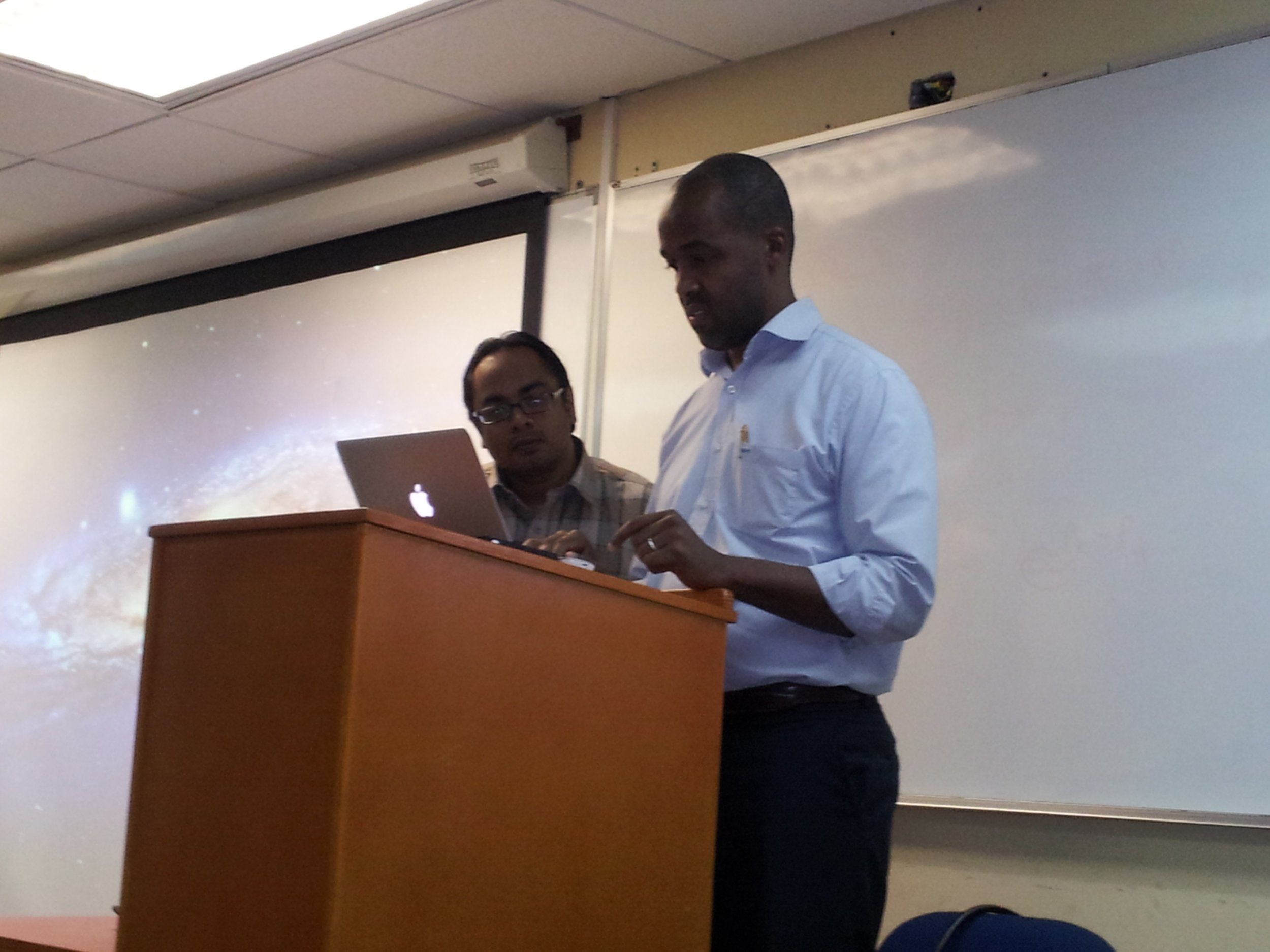
CAPTION: Dr Kenfield Griffith, CEO, mSurvey and Anil Ramnanan, PhD student at The University of the West Indies (UWI) Department of Computer Studies, at mSurvey’s workshop on Data Collection and Surveying using Mobile Technology, held at the Max Richards Building, Faculty of Engineering , UWI St Augustine on March 28, 2014. PHOTO: GERARD BEST A mobile SMS-based survey service from a Caribbean-based company could change the way data is collected and analysed in the region.


If Kenfield Griffith has anything to say about it, his company will soon be adding potent fuel to the digital revolution smouldering quietly throughout the islands of the Caribbean.


Born in Montserrat and of Barbadian extract, Griffith is the CEO of mSurvey, a mobile surveys company based in Kenya. Kristal Peters, Director of Business Development and Strategy, runs the company’s Trinidad and Tobago office.


"It's Friday morning. Let's create a survey together," Griffith says to a group of relative strangers gathered in a small room in the Max Richards Building at the Faculty of Engineering of The University of the West Indies, St Augustine for mSurvey’s workshop on data collection and surveying using mobile technology.


His confidence seems well placed. Within minutes, the demo survey is set up and sent to a pool of prospective participants located in Kenya and Trinidad and Tobago, who immediately start returning their responses via SMS technology. Soon, their data start streaming in to a dynamic web page, which aggregates and visualises the survey results in real-time. In no time at all, the roomful of workshop participants, about fifty in all, are analysing the fresh data.


The audience is an interesting mix of academics, researchers, policy makers, mobile carrier representatives, students and software developers, and many seem eager to learn more.


“Do you sell data to third parties?” asks one man seated toward the middle of the room.


"We have the technology that folks use to get other people's data. But we don't sell anyone's data to third parties," Griffith replied.


Moments later, he clarified his business model. The primary service that mSurvey provides is to help people, businesses and organisations to use mobile technology to get the precise data they need to make high-impact decisions quickly.


"We're trying to solve a problem here and that problem is getting data.”


To have some idea of what Griffith means, you need only to have tried to get survey data quickly and reliably in the Caribbean context. For many organisations trying to use survey data to harvest meaningful insights and increase their ROI, the biggest stumbling block is the inability to gather data in the first place. Door-to-door surveys are costly and painfully slow. Open data sources like the World Bank are always just a click away but don't necessarily give the specific insights required for contextual decision-making. And commissioned online surveys are challenged by the limits of the local population's access and connectivity to the Internet. By some estimates, residential broadband Internet penetration in Trinidad and Tobago, for example, remains as low as 45%.


“Getting information in emerging markets is a pain point for most of us,” Griffith said.


But for every problem, a solution. Mobile penetration in Caribbean islands like Trinidad and Tobago can be as high as 140%. Everyone, statistically speaking, has a phone...or two. So the mSurvey platform allows the entire survey process to be completed over a regular mobile SMS plan at no cost to participants. Respondents don’t need mobile or Wi-Fi broadband Internet connection, nor even a smartphone.


For mSurvey, the ubiquity of the mobile phone has become the answer to one of the region's biggest obstacles to data collection.

Surveying the region: Changing the game for data collection in the Caribbean

A mobile SMS-based survey service from a Caribbean-based company could change the way data is collected and analysed in the region.

If Kenfield Griffith has anything to say about it, his company will soon be adding potent fuel to the digital revolution smouldering quietly throughout the islands of the Caribbean.

Born in Montserrat and of Barbadian extract, Griffith is the CEO of mSurvey, a mobile surveys company based in Kenya. Kristal Peters, Director of Business Development and Strategy, runs the company’s Trinidad and Tobago office.

"It's Friday morning. Let's create a survey together," Griffith says to a group of relative strangers gathered in a small room in the Max Richards Building at the Faculty of Engineering of The University of the West Indies, St Augustine for mSurvey’s workshop on data collection and surveying using mobile technology.

His confidence seems well placed. Within minutes, the demo survey is set up and sent to a pool of prospective participants located in Kenya and Trinidad and Tobago, who immediately start returning their responses via SMS technology. Soon, their data start streaming in to a dynamic web page, which aggregates and visualises the survey results in real-time. In no time at all, the roomful of workshop participants, about fifty in all, are analysing the fresh data.

The audience is an interesting mix of academics, researchers, policy makers, mobile carrier representatives, students and software developers, and many seem eager to learn more.

“Do you sell data to third parties?” asks one man seated toward the middle of the room.

"We have the technology that folks use to get other people's data. But we don't sell anyone's data to third parties," Griffith replied.

Moments later, he clarified his business model. The primary service that mSurvey provides is to help people, businesses and organisations to use mobile technology to get the precise data they need to make high-impact decisions quickly.

"We're trying to solve a problem here and that problem is getting data.”

To have some idea of what Griffith means, you need only to have tried to get survey data quickly and reliably in the Caribbean context. For many organisations trying to use survey data to harvest meaningful insights and increase their ROI, the biggest stumbling block is the inability to gather data in the first place. Door-to-door surveys are costly and painfully slow. Open data sources like the World Bank are always just a click away but don't necessarily give the specific insights required for contextual decision-making. And commissioned online surveys are challenged by the limits of the local population's access and connectivity to the Internet. By some estimates, residential broadband Internet penetration in Trinidad and Tobago, for example, remains as low as 45%.

“Getting information in emerging markets is a pain point for most of us,” Griffith said.

But for every problem, a solution. Mobile penetration in Caribbean islands like Trinidad and Tobago can be as high as 140%. Everyone, statistically speaking, has a phone...or two. So the mSurvey platform allows the entire survey process to be completed over a regular mobile SMS plan at no cost to participants. Respondents don’t need mobile or Wi-Fi broadband Internet connection, nor even a smartphone.

For mSurvey, the ubiquity of the mobile phone has become the answer to one of the region's biggest obstacles to data collection.