South School on Internet Governance comes to Trinidad
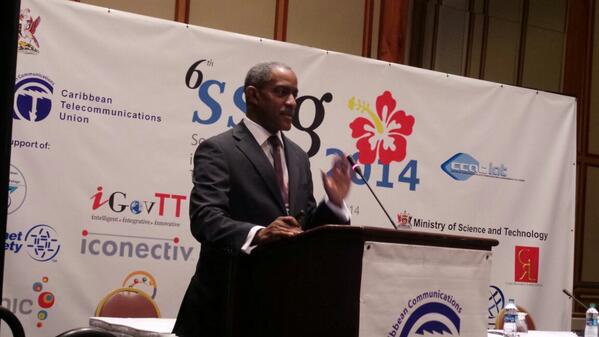
Albert Daniel, ICANN Caribbean Manager, explained the ICANN's role in Internet Governance...in plain English! EVENTS - The Caribbean Telecommunications Union (CTU) and the ICT Training Centre for Latin America and the Caribbean (CCAT-LAT) are bringing a five-day intensive training programme to the Caribbean, which aims to improve the quality of regional representation at international Internet Governance meetings.

The South School on Internet Governance, or SSIG, is a programme to prepare Caribbean and Latin American participants to actively participate in international meetings that determine the future of the Internet. The aim is to increase the level and quality of representation of Latin American and Caribbean countries at regional and international Internet Governance fora.

The Trinidad and Tobago Government, through the Ministry of Science and Technology, will be hosting the sixth edition of the SSIG. The event will take place in Hilton Hotel, Port-of-Spain, from April 28th to May 2nd. It will be the first time in its history that the SSIG will be held in the Caribbean.

“The CTU fully supports of the convening of the South School on Internet Governance in the region, as that venue gives Caribbean stakeholders greater access to benefit from the programme,”  said Bernadette Lewis, CTU Secretary General.

With more than half of the registered participants from the region, the programme is preparing participants to engage in the formulation of national, regional and international Internet policy, addressing with a special focus on Caribbean issues. Participants are interacting with local, regional and international experts in a range of technology-related areas.

“The Internet is a global resource, and governing it requires a multi-stakeholder approach. That’s why SSIG participants are given an understanding of the global Internet ecosystem and its evolution,” said Dr Olga Cavalli, Director of the SSIG.

Cavalli, a Lecturer in Networking, Telecommunications and Informatics at the University of Buenos Aires, is Argentina Representative for ICANN and a member of Advisory Committee to the United Nations Secretary General for the global Internet Governance Forum.

Director of Institutional Relations at SSIG is Adrian Carballo, a former coordinator of the ICT Financing Group in the Strategy for the Information Society in Latin America and the Caribbean (e-LAC), coordinated by the Economic Commission for Latin America and the Caribbean (ECLAC) of the United Nations.

“The principal objective is to create a new kind of leader, one who is better equipped to represent the needs of the region,” Carballo said.

SSIG 2014 participants, drawn from the public and private sectors, civil society as well as academia, will have the opportunity to network with members of organisations such as the Latin America and Caribbean Network Information Centre (LACNIC), the Internet Society (ISOC) and the Internet Corporation for Assigned Names and Numbers (ICANN), which help to shape the future of the Internet.

Since its inauguration in 2009 in Argentina, the location of the SSIG has been rotated annually to Sao Paolo, Mexico City, Bogota and Panama City. Emily Fitzpatrick, Business Development and Research Officer at CTU, completed SSIG 2012 in Bogotá, Colombia. Initiatives like the SSIG can play an important role in fostering healthy dialogue about Internet Governance in the Caribbean, she said.

“SSIG is a diverse and safe forum where people with varying levels of expertise, knowledge and capacity can have meaningful dialogue. The real beauty of SSIG is the ability to sit in small groups with colleagues converse and reflect on the flow of information coming from the presenters. The cross-pollination that takes place in that forum is healthy and needed in the region.”

Selected SSIG sessions will be livestreamed online and open to remote participation in Spanish and English. Full course details are available on the official SSIG website, www.gobernanzainternet.org and on the CTU’s official website, www.ctu.int.

Dominica hosts seventh regional CaribNOG meeting

caribnog logoEVENTS -  Regional and international technology experts are gathering in Dominica to address Caribbean technology challenges and to collaboratively derive solutions that are relevant to the region. The Caribbean Network Operators Group, CaribNOG, is hosting its seventh regional meeting in the island’s capital city, Roseau, from April 28 to May 2.

CaribNOG is a forum for network technicians and technology professionals from across the region to share experiences and participate in expert-led, high-tech training exercises and hands-on technical workshops.

“The Caribbean is at an interesting juncture with respect to its growing dependence on Internet-related technologies. The region is extremely vulnerable to cyber attacks and has to take steps to develop its technical human resource capacity. CaribNOG is key part of the response to that challenge,” said Bevil Wooding.

Wooding, one of the founders of CaribNOG, cited examples from around the world where similar volunteer groups have emerged and now collaborate to help protect local networks against mounting threats, and to keep pace with technology change.

CaribNOG 7 follows a series of workshops and training events held across the Caribbean in 2013, including two regional meetings in Barbados (CaribNOG 5) and Belize (CaribNOG 6). Sessions will focus on network design, mobile network infrastructure, cyber security, Internet Exchange Point management and cloud infrastructure.

Stephen Lee, CaribNOG’s programme coordinator, described the work of the volunteer-based group as “invaluable for advancing the technical skills of ICT professionals in the region who design, manage or secure the network infrastructure”.

The CaribNOG meeting is being streamed via the Internet for remote participants. Participants are drawn from the Caribbean, Latin America and North America and as far away as Europe and Africa. The event is being hosted by the Dominican National Telecommunications Regulatory Commission (NTRC) at the Fort Young Hotel in the capital city of Roseau.

WANTED IN THE CARIBBEAN: Regional Response to Global Climate Change

[getty src="155142796?et=-ehrW-BcQbNh4tuKeoe58A&SeoLinks=on&sig=GZAvflkfYvTRXpdWAUB2Sf55OKiriSzIjZ1gpXtCLtQ=" width="507" height="398"]


Will Caribbean leaders work together to respond to the global challenge of climate change? The question arises as the United Nations’ Intergovernmental Panel on Climate Change (IPCC) continues to release its latest global report on climate change, which is scheduled for completion in October 2014.

The IPCC’s periodic reports are intended to provide the world with a clear scientific view on the potential environmental, social and economic impacts of climate change. The current report, its fifth, is known as AR5, and it outlines several severe direct impacts of climate change on human life and the ecological well-being of the entire planet.


Among the major predictions in the first volume of the report, released in September 2013, are:

• Further warming will continue if emissions of greenhouse gases continue

• The global surface temperature increase by the end of the 21st century is likely to exceed 1.5°C, and is likely to exceed 2.0 °C for many scenarios

• Increases in disparity will appear between wet and dry regions, as well as wet and dry seasons

• The oceans will continue to warm, with heat extending to the deep ocean, affecting circulation patterns

• Global mean sea level will continue to rise at a rate very likely to exceed the rate of the past four decades

• Changes in climate will cause an increased CO2 production rate, leading to increased ocean acidification

• Future surface temperatures will be largely determined by cumulative CO2, which means climate change will continue even if CO2 emissions are stopped


“While these direct impacts are grim, particularly for a region of small island developing states, it is the indirect impacts of climate change that are of even greater concern,” said Norman Gibson, Scientific Officer, Caribbean Agricultural Research and Development Institute (CARDI). “For example, climate change can lead, indirectly, to increased poverty, decreased wellness, higher insecurity, greater migration and human conflict.”


The Barbados-born Gibson, who is attached to the CARDI headquarters, physically located on The University of the West Indies’ St Augustine campus, explained why the the Caribbean region is particularly vulnerable to social and economic fallout of climate change.


“Most of the economies in this region depend heavily upon tourism and agriculture, despite the fact that the services sector is responsible for much of the GDP output. Tourism and agriculture contribute immensely to employment and social stability. These sectors rely upon natural resources and are particularly susceptible to climate variability and change,” he said.


AR5 suggests that the Caribbean region’s vulnerability is likely to increase in the near-term, with significant negative effects on tourism and agriculture if appropriate mitigation and adaptation measures are not quickly adopted. Of course, the region is not alone in this regard. As World Bank Group Vice President and Special Envoy for Climate Change Rachel Kyte pointed out: "The latest IPCC report paints a picture of a complicated future where no one gets by unscathed, where existing vulnerabilities are exacerbated and where we need to prepare for the worst.

Following are some of the major impacts outlined in IPCC AR5 Volume 2, released in March 2014.

• If the rise in global temperature rise exceeds 4°C, there will be major negative impacts on agricultural production worldwide, and extinction of a substantial proportion of the earth's species.

• Ocean acidification is very likely to lead to reduced coral calcification, which is projected to have a negative impact on tourism and fishing industries.

• High ambient CO2 concentrations in the atmosphere will affect human health by decreasing the nutritional quality of important food crops

• The increasing prices of food commodities on the global market due to local climate impacts are likely to decrease food security.

• Climate change will bear significant consequences for human migration flows, creating a combination of risks and benefits for migrants and nations.


“Decision-makers in our region must now work together to formulate a multistakeholder approach to the myriad issues raised by climate change,” Gibson said. “The burden of responsibility cannot rest solely on governments, but all sectors of society should respond to the call--academia, public and private sector entities, civil society and regular citizens. Everyone is affected, and all should play a role in shaping our response.”

[getty src="154890047?et=p8qD01yZTkRLPcP_LpRG9w&SeoLinks=on&sig=ZAsjkFzBXTQfDxzLgj6mAvYnTaAJECYmisC9UGZXrRo=" width="508" height="398"]

While Caribbean islands need to work intra-regionally to develop a coherent Caribbean perspective, there is equally a requirement for the region as a whole to work in concert with major decisions being made on the international stage. Each region’s response can have a negative side effect on another, Gibson explained. For example, the mass migration of lionfish to Caribbean waters highlights how invasive marine species can be detrimental to foreign ecosystems. Also, the decision to develop biofuels as energy sources in one part of the world can increase food prices and affect land use practices elsewhere.

Norman Gibson, Scientific Officer, CARDI


“The Caribbean must take part more actively in policy formation processes at the international level because decisions are being made there which can have serious implications for our quality of life here,” Gibson said.

The Regional Framework for Achieving Development Resilient to Climate Change, approved by the Caribbean Community in 2009, provides a road map for Caribbean action on climate change over the period 2011 to 2021. The framework underscores the importance of a common regional approach to address the threats and challenges of climate change.


An Implementation Plan, which was subsequently developed to guide the delivery of the Regional Framework, calls for a change in mindset, institutional arrangements, operating systems, collaborative approaches and integrated planning mechanisms in order to deliver the strategic elements and goals of the regional framework.


But AR5 puts squarely into perspective the need for urgent and concerted action.


“Caribbean leaders have arrived at a crossroads,” he said, “and it is time that the rhetoric is matched by investment in actual doing. Urgent and sustained measures must be taken now to tackle the crucial issues raised by AR5. It is clear that a regional dialogue with all stakeholders is required and Caribbean leaders must seize this moment and make sure that this growing challenge is met with an appropriate response.”