Mobile telecommunications operators in the region will continue to take advantage of consumers until stronger regulatory frameworks are built to protect Caribbean citizens. Regulators across the region must take decisive action to protect consumer choice, and the neutrality of the Internet across the Caribbean.
This is the consensus emerging among several Latin America and Caribbean Internet and telecommunications industry experts who spoke to the T&T Guardian after a move by regional mobile operators Digicel and LIME to block Voice over Internet Protocol (VoIP) services over their networks in Haiti, Jamaica and T&T.
Digicel’s decision to take action against the VoIP operators was first announced last month in Haiti, where their customer base of four million mobile broadband subscribers includes some 200,000 users of VoIP services such as Magic Jack, Google Talk, Viber, Tango and FaceTime. Digicel customers in Haiti were soon joined by their counterparts in Jamaica, where mobile competitor LIME also banned Viber.
In T&T, the move triggered backlash from concerned consumers, many of whom immediately took to social media to express their concern and displeasure. The Telecommunications Authority of Trinidad and Tobago (TATT) later announced via press release that it had requested that Digicel reconsider its position, while a post on the telco’s
Facebook page said it was “pleased to resume all VoIP-based products while TATT is engaged in investigating the negative impact of unlicensed providers and the adverse impact they have on infrastructure based investment in Trinidad and Tobago.”
But many industry watchers are describing the move by Digicel as unjustified and dangerous.

- Dr Kim Mallalieu
“As far as I am aware, subscribers pay service providers for access to the Internet. As far as I am aware, service contracts do not specify what form the information transported must take. I do not see the justification for blocking VoIP,” said Kim Mallalieu, Senior Lecturer, Department of Electrical and Computer Engineering, The University of the West Indies, St Augustine.
“The implications are very straightforward: customers lose since they are prevented from using applications that for many of them justify having a [mobile broadband Internet] connection,” said telecom analyst Jose Otero, president of industry intelligence firm Signals Telecom Consulting.

“It’s also bad news for local developers who may see their applications blocked by mobile operators if they consider them to be competing with one of their services. However, at the end of the day it’s an issue that needs to be solved by each island’s local regulatory authorities.”
The T&T Guardian also contacted the Latin America and Caribbean Network Information Centre (LACNIC), one of five regional Internet registries which provide critical background services that support the global operation of the Internet.
“Measures like these degrade, discriminate, block and prejudice the rights of users in activities Internet based,” said Cesar Diaz, expert on regulatory frameworks at LACNIC.
The “Internet ecosystem”, Diaz explained, depends on regulators’ ability to defend a number of fundamental rights including users’ right to access legitimate content and applications of their choice, freedom of expression, and the right to privacy and confidentiality of communications.
“Regulators should enforce basic principles for the protection of consumers from arbitrary and unnecessary restrictions on the use of Internet. Users must have within their services agreements access to legitimate content of their choice. You must be able to run applications of their choice, and connect any device of your choice to access the Internet.”
Without impairing the rights of operators, industry regulations should promote the development of the Internet market, expand its access to more users and improve the quality of services, said Diaz, who worked for the Panamanian regulator ASEP before joining LACNIC.
Stronger consumer protection needed
“Latin American operators are not going to block mobile VoIP since they already lost that battle over ten years ago when they tried to block fixed VoIP,” Otero said.
He and Diaz are among several local and international observers who are saying that regulators such as TATT, Haiti’s National Telecommunications Council (CONATEL) and Jamaica’s Office of Utilities Regulation (OUR) must now take swift, strong action to protect Caribbean consumers.

- Bevil Wooding
“The action of these ISPs sets a dangerous precedent and could have a deleterious impact on efforts to leverage ICTs for both economic and social development across the region,” said Internet Strategist and Business Guardian columnist Bevil Wooding, in a strongly worded opinion piece on the emerging situation.
According to telecom industry analysts, the move by Digicel and LIME is motivated by falling revenues and voice traffic, as consumers increasingly look for ways to bypass costly calling rates, Jacquelines Charles writes in a Miami Herald report on the developing situation.
It is because mobile service providers impose such high international call termination rates and “artificially high” intra-regional roaming charges that Caribbean consumers are fighting to hold on to VoIP alternatives, Wooding pointed out.
“Why are roaming costs and international call rates so expensive? And who benefits the most from this? There are reasons why Internet-based voice services like Skype, Viber, Vonage and Magic Jack so popular. These services provide consumers and business across the region with an affordable option for communicating with friends, family and business partners.”

- Shernon Osepa
Data, not minutes, is the new currency for telecom providers, said Wooding, adding that Caribbean telecom providers have not evolved to meet the realities of business in the Internet age. Shernon Osepa, a telecommunications industry analyst specialising in Internet Policy, agreed.
“Digicel is a mobile operator with voice services as one of its main services. You would notice that they don't mind if consumers are just "browsing" the Internet. That doesn't affect them. They have problems with applications such as Skype and Viber as these are a direct threat to their own voice services.”
“The regulator should promote sound competition which will lead to innovative services and affordable prices. It should also protect consumers from abusive behaviors. On the other hand, operators must also be able to adapt their business models constantly in order to be in harmony with technological developments.”
But, Osepa said, most regulators “don't really understand the Internet economy”, and they therefore need to quickly learn more about the new rules of engagement in order to do their jobs more effectively.
“This is the only way they can draft sound policies in this modern world.”
TATT’s policy on the procedures for the introduction of tariff changes, promotions, new services and bundles in the telecommunications sector remains a draft document.
“This is probably a case where the government should initiate a public dialogue to determine the appropriate public policy approach that encourages further investment by operators like Digicel while also creating opportunity for innovation and ensure the protection of consumer interests,” Osepa said.
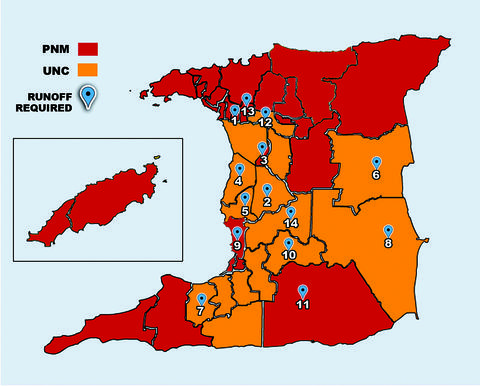 If the constitutional changes being proposed by Prime Minister Kamla Persad-Bissessar were in effect during the 2007 general election, former United National Congress (UNC) political leader Basdeo Panday would have been forced to face a runoff vote for his Couva North seat. And he would have had plenty company.
On Monday, the PM proposed a series of changes to the electoral process, including term limits, the right to recall non-performing MPs and the introduction of a second ballot runoff vote system.
If the constitutional changes being proposed by Prime Minister Kamla Persad-Bissessar were in effect during the 2007 general election, former United National Congress (UNC) political leader Basdeo Panday would have been forced to face a runoff vote for his Couva North seat. And he would have had plenty company.
On Monday, the PM proposed a series of changes to the electoral process, including term limits, the right to recall non-performing MPs and the introduction of a second ballot runoff vote system.