Curacao to host CaribNOG 8/LACNIC Caribbean 6

curaçao flagOne of the largest gatherings of the Caribbean Internet community will take place in Curacao in a few weeks. In September, the Caribbean Network Operators Group (CaribNOG) and the Latin American and Caribbean Internet Addresses Registry (LACNIC) will co-host a regional forum where important issues related to the future of the Internet at a regional and global level will be discussed.

CaribNOG 8/LACNIC Caribbean 6 will provide a forum for technology industry specialists to meet, network and get specialised training. The highly-anticipated event is widely regarded as a solutions-oriented forum for regional technology professionals to share relevant knowledge, deepen practical understanding and develop new skills.

The week of meetings draws on the strength of two organisations that are committed to advancing Internet development in the region. CaribNOG has earned a reputation as a place to exchange information related to the management of Internet and telecommunications networks in the region. LACNIC, an international non-government organisation, is one of the five Regional Internet Registries that exist worldwide.

Cyber security, Internet exchange points, data centres, cloud computing and critical Internet infrastructure are among the main topics to be presented by a slate of experts that includes Carlos Martínez (LACNIC), Bevil Wooding (PCH), Mark Kosters (ARIN), Arturo Servin (Google Inc.), Claire Craig (UWI), Steve Spence (Arkitechs), Alejandro Acosta (LACNIC), Stephen Lee (Arkitechs).

The regional event takes place with the support of the wider global Internet community. Among its main sponsors are the Amsterdam Internet Exchange (Ams-IX), the American Registry for Internet Numbers (ARIN), the Caribbean Telecommunications Union, Columbus Communications, Google, the Internet Corporation for Assigned Names and Numbers (ICANN), the Internet Society, the Brazilian Network Information Center (NIC.br) and Microsoft.

CaribNOG 8/LACNIC Caribbean 6 will be held from September 29 to October 3 at Hilton Curaçao Resort Hotel, Willemstad.

“Curacao is a very appropriate location for this event,” said Stephen Lee, one of the main organisers.

The island is one of the few in the Caribbean that has developed its Internet infrastructure to the extent that it is able offer data centre services to a global market, including the southern and eastern Caribbean.

“Technology-based services are an important part of the economy. They have modern high-speed connectivity, and there are some major fibre connections into the island that enable them to support the delivery of those services.”

More information is available on the official event website.

Call For Participants: CARCIP Funds Youth ICT Skills Programme

CASTRIES, Saint Lucia—Applications are invited for entry into the CARCIP Information Communication Technology (ICT) Skills Development programme.

The programme will provide free training and certification to unemployed youth between the ages of 17 -35 years in the following areas:

Photography, Database Management, Systems Analysis and Design, Internet Security, Multimedia Production/Animation, Application Development, Computer Graphics, Automotive Technology, End Point Maintenance & Repair, and Information Communication Technology/ IT Management.

To encourage islandwide participation, training will be offered at select training institutions in the north and south of the island.

Eligible persons must be holders of a minimum of three CXC’s or have at least one year of working experience in the course of interest. Applicants must also meet the specific requirements of the selected programme.

The CARCIP Skills Development Programme is currently being implemented by the Ministry of Public Service, Information & Broadcasting in collaboration with the TVET Unit, Ministry of Education. The programme is part of the Government’s overall strategy to increase economic growth through the enhancement of productivity and technical expertise within the local ICT sector.

Application kits as well as course information are available on the CARCIP website. Spaces are limited so please apply early.

For further information contact us at 468-4977, email info.carcip@govt.lc or visit the CARCIP office at the National ICT Center on Bourbon St., Castries.

How new runoff rules would have impacted 2007 polls

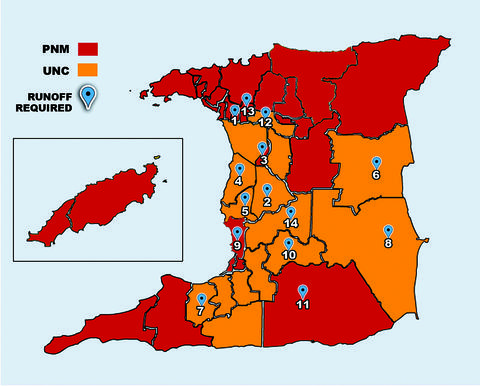
2007 Run off constituenciesIf the constitutional changes being proposed by Prime Minister Kamla Persad-Bissessar were in effect during the 2007 general election, former United National Congress (UNC) political leader Basdeo Panday would have been forced to face a runoff vote for his Couva North seat. And he would have had plenty company. On Monday, the PM proposed a series of changes to the electoral process, including term limits, the right to recall non-performing MPs and the introduction of a second ballot runoff vote system.

“A runoff poll is proposed so that each member of the House of Representatives will only become such a member if he obtains more than 50 per cent of the votes cast in a constituency,” the PM said. The map (Page A1) of the 2007 general elections results highlights the potential impact of that specific proposed constitutional change. Fourteen of the 41 electoral districts—more than 33 per cent of the available seats—would have required a runoff vote.

That election was won 26-15 by the People’s National Movement and interestingly, the winner is likely to have remained the same, as the runoffs would have been required mostly in the 15 constituencies won by the UNC. Including Panday, a total of nine UNC candidates would have gone back to the polls for runoffs, in Caroni Central, Couva North, Couva South, Cumuto/Manzanilla, Fyzabad, Mayaro, Princes Town North, Tabaquite and Vasant Bharath’s St Augustine.

Bharath’s runoff would have been against his current coalition counterpart Winston Dookeran, who was then political leader of the Congress of the People (COP). The remainder of the UNC wins—Caroni East, Jack Warner’s Chaguanas West, Naparima, Roodal Moonilal’s Oropouche East, Oropouche West and the Prime Minister’s Siparia constituency—would have been won outright. The People’s National Movement (PNM) would also have been affected, although to a lesser degree.

Of their 26 seats, five would have been returned to the polls—Barataria/San Juan, Chaguanas East, Pointe-a-Pierre, Princes Town South/Tableland and St Joseph.

In this scenario, the PNM would still have won 21 seats outright—Arima, Arouca/Maloney, D’Abadie/O’Meara, Diego Martin Central, Diego Martin North/East, Diego Martin West, La Brea, La Horquetta/Talparo, Laventille East/Morvant, Laventille West, Lopinot/Bon Air West, Point Fortin, Port-of-Spain North/St Ann’s West, Port-of-Spain South, San Fernando East, St Ann’s East, Tobago East, Tobago West, Toco/Sangre Grande and Tunapuna.

In the May 24, 2010 polls, none of the winning candidates got less than 50 per cent of the votes so no runoffs would have been needed. The People’s Partnership coalition government beat the PNM 29-12 in that election.

From T&T Guardian