How will regional regulators respond to CWC's acquisition of Columbus?

Can telecommunications regulators from across the Caribbean see beyond their national interests and present a unified regional response to a common challenge? The recent announcement by Cable and Wireless (CWC) of its proposed US$3 billion acquisition of Columbus International could prompt them to try. If approved, the deal will make CWC the Caribbean’s largest wholesale and retail broadband service provider. But the acquisition requires regulatory approval in Trinidad and Tobago, Jamaica and Barbados.

Against this backdrop, the Caribbean Telecommunications Union (CTU) is convening a special meeting of regulators, economists and industry experts, in an effort to forge region-wide consensus around the regulatory issues arising from the proposed deal. The CTU Secretariat hopes, after the two-day meeting, to be able to advise Caribbean Community (Caricom) heads on measures to be taken to mitigate against the expected fallout from the CWC acquisition.

National regulators, such as the Telecommunications Authority of Trinidad and Tobago (TATT), and sub-regional regulators, such as the Eastern Caribbean Telecommunications Authority (ECTEL), Jamaica's Office of Utility Regulation, Barbados' Fair Trading Commission and the Bahamas' Utilities Regulation and Competition Authority, have been invited to take part in the high-level meeting, alongside invited representatives from the CTU member states.

Earlier this week, ECTEL issued a statement warning that the proposed CWC-Columbus deal could result in a negative impact on competition, and reduce choice by consumers of both services and service providers.

The sub-regional body said increased monopolisation could “erode the gains made by the liberalisation and create challenges for the entrance of new service providers.”

Both CWC and Columbus could be in breach of their licenses if they engage in activities, which can unfairly prevent, restrict, or distort competition, ECTEL said, adding that it would work with other Caribbean regulators to advise member governments on the pressing issue.

​The announcement of CWC-Columbus deal, on November 6, followed a joint venture entered into by both companies in late 2013, through which they agreed to share regional subsea fibre assets. News of the development sparked concerns that the deal could return several Caribbean territories into monopoly or near-monopoly markets for telephony, cable TV and broadband services.

The upcoming CTU regulatory forum, which takes place on December 10 to 11, will also seek to address other relevant issues, such as the removal of voice and data roaming charges, number portability, over-the-top services, open reporting and social investment by telecom providers. The need for stronger, more coordinated regional regulation practices was highlighted in July of this year, after mobile phone users in Haiti, Jamaica and Trinidad and Tobago were affected by a move by major regional mobile providers LIME (a CWC subsidiary) and Digicel to block access to OTT telephony services—including several popular Voice over Internet Protocol (VoIP) applications.
Guardian partners with Caribbean GIS to track chikungunya in the Caribbean

Screen Shot 2014-10-20 at 3.10.41 PM-2

Everything about chikungunya is painful. Even the virus’ name comes from a Kimakonde word describing the contortions of one suffering severe joint ache. Fever, rash, cramps, headache, nausea and fatigue are just some of the symptoms of the mosquito-borne illness.

Nor is tracking the spread of the disease across the Caribbean any easier. English-language reports on the virus’ transmission at the sub-regional level are put out by public health authorities, including the Caribbean Regional Public Health Agency (CARPHA), the Pan American Health Organisation (PAHO) and the Center for Disease Control (CDC).

But keeping up with information from all of these sources can be time-consuming, especially if you just want to keep an eye on the spread of the disease in your own country, or get a sense of the broader regional picture.

“It’s easy to point a finger and criticise but I thought it would be better to actually demonstrate that something better could be done,” said Vijay Datadin, founder and lead consultant at Guyana-based Caribbean GIS.

Datadin should know. He’s made a career of applying geographic information systems (GIS) to the complex interrelationships between human and natural resources.

“When I looked at the outputs of CARPHA, PAHO and even the CDC, I thought they could be enhanced. Specifically, PAHO is putting out data reports in PDF format, which is really less than ideal. Where there are maps, they could be made more informative and charts would help citizens understand the situation more easily. I felt it could be done better, because they’re still doing it in the old-fashioned way.”

Datadin is co-lead on a new open data project that aims to fix two major pain points associated with the “old-fashioned way” of sharing public health data. First, as a one-stop resource for official chikungunya numbers, the online tracker seeks to cut out the hassle of having to check multiple websites, in order to get the latest collated statistics on the spread of the virus.

The second pain point is how chikungunya transmission data are presented by the three leading public health agencies in the Americas. Modern public health sites like HealthMap aggregate news reports in real-time and push notifications to subscribers, filtering by relevance based on geolocation. They are built with responsive design to dynamically adapt to different form factors such as mobile devices, tablets and desktop screen displays. Plus they are mobile-optimised for lightweight browsing, and social-friendly for maximum user engagement.

By comparison, the regional websites are less impressive. The CDC website provides a static map showing countries where local transmission has been documented, and says that “chikungunya case counts are publicly released every Wednesday.” PAHO provides a weekly report every Friday afternoon of Chikungunya counts for most countries of the Americas and a static map showing countries with local and imported cases. CARPHA provides a weekly update of Chikungunya counts every Monday. The CARPHA site also has an interactive map with a useful timeline feature illustrating the progression of the disease through the region and mouse-over info boxes showing the number of cases in a country.

The region's public health services could learn from the open data approaches that are becoming the expected standard for providing public information, Datadin said.

“Around the world, public organisations are no longer simply publishing their data in PDF format or static maps but in open data formats and interactive maps. The value in doing it this way is that data scientists, researchers and other interested parties are then able to not just see the data but actually use it,” Datadin said.

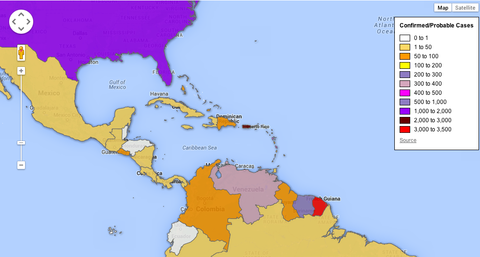
His latest project, a joint initiative of Caribbean GIS and the T&T Guardian’s new media unit, brings to traditional public health reporting the transparency of open data formats and the interactivity of data visualisation. The end-product is an online map-based chikungunya tracker that makes it easy for anyone with Internet access to follow the regional diffusion of the disease, using public health data extracted from official sources. The tracker is online at http://www4.guardian.co.tt/map-chikungunya-caribbean.

Data for the map and charts on this page were extracted from PDF reports published by PAHO, reformatted and combined with a GIS base map. On the Caribbean GIS Health site the map is accompanied by other charts and timelines that provide historical context and make each country’s demographic situation easier to grasp at a glance.

The  improved Chikungunya dataset is also made freely available as a Fusion Table so that other researchers, students and citizen scientists can view, filter or merge with other data with just a browser, or download for further analysis.

Mapping Caribbean Crime

The joint project isn’t Datadin’s first foray into data journalism. In 2003, Datadin founded Red Spider, a small web development startup, which today maintains the Guyana Crime Reports,  an open data tracker for several categories of serious crime in Guyana. The website is part news aggregator, part crowd-sourced citizen journalism platform.

In 2013, Guyana Crime Reports collaborated with the now-defunct Bullet Points, an earlier open data journalism project involving Guardian’s new media desk, which tracked intentional homicide as well as deaths caused by shootings involving police officers. Datadin, who was at the time working on Guyana Crime, worked with Bullet Points to develop a GIS-powered map of 384 murders in its 2013 dataset.

“I feel that the Caribbean is better off when its citizens are better informed,” Datadin said.

Jamaica's Team Node420 wins regional code sprint in Suriname

From left, Guyanese Agriculture Minister Dr Leslie Ramsammy presents the first-place prize cheque for 5,000 euros to Matthew Mc Naughton and Jamaican team Node420, at the award ceremony for the Agrihack Caribbean Talent competition in Paramaribo, Suriname, on October 9. Photo courtesy: The Technical Centre for Agricultural and Rural Cooperation ACP-EU (CTA)​. A group of Jamaican developers won top regional honours in a regional hackathon, held as part of the Caribbean Week of Agriculture in Suriname.

Team Node420 beat seven other teams of young developers in the #agrihack, held in Paramaribo from October 5 to 9.

Their winning app is designed to give farmers real-time weather analysis, allowing more efficient agricultural planning.

The Guyanese Minister of Agriculture presented the 5,000 Euro prize.

A team from Barbados walked away with 4,000 Euros—presented by the Director General of  the Inter-American Institute for Cooperation on Agriculture—for their app. Called Crop Guard, it aims to enhance food security by helping farmers to protect their crops through pest diagnosis, monitoring and control.

Third-place winners Unicode of Suriname received a 3,000-Euro prize from Michael Hailu, director of event organisers, the Technical Centre for Agricultural and Rural Cooperation ACP-EU (CTA)​.

Contestants presented their products before a regional panel and an audience that included participants of the Caribbean Week of Agriculture.

Each team competing at the regional event worked with a tech hub, an organisation that gave the team advice and helped them to fine-tune the apps they developed.

Node420 was supported by SlashRoots, Crop Guard were supported by the National Council for Science and Technology of Barbados, while Unicode  got help from Telesur Multimedia Innovation Laboratory.

Those tech hubs also won 3000 Euros each, to facilitate business incubation for the top three winners.

The AgriHack Talent Caribbean was organised by the CTA and various partners to support youth ICT innovations and entrepreneurship in agriculture. This activity is supported by the Agriculture, Rural Development and Youth in the Information Society (ARDYIS) project of CTA.

Eight teams from six Caribbean countries were at the finals. In addition to the regional prizes, each won 800 Euros, as the national-level prize.

The three regional winners are now looking forward to six months of business incubation, also part of the prize-package, during which time they will have access to guidance and support to develop their winning business ideas.

From T&T Guardian